The 5-Factor Framework for Winning Visibility Across Search, Social & AI (F.A.C.T.S.)
For years, digital visibility had a fairly simple formula: create a website, optimize it for Google, build backlinks, and work your way up the search results.
That formula still matters. But search behaviour has changed.
People now discover businesses through Google, Instagram, YouTube, Google Maps, Reddit, social platforms, AI assistants, and tools such as ChatGPT and Perplexity. A potential customer might search for a service on Google, check the brand’s Instagram page, read reviews, look at Google Maps, and then ask an AI tool for a recommendation before making a decision.
This means being visible online is no longer just about ranking a webpage.
Brands need to become discoverable wherever their customers are looking for information.
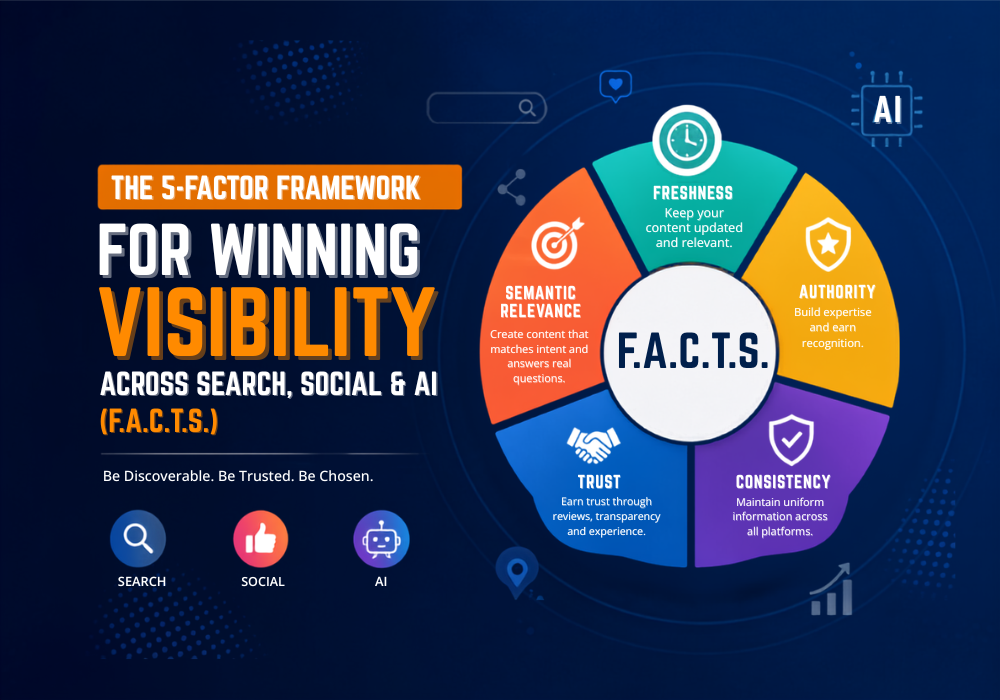
This is where the F.A.C.T.S. framework becomes useful. F.A.C.T.S. stands for Freshness, Authority, Consistency, Trust, and Semantic Relevance. The framework was developed as a way of thinking about “Search Everywhere Optimization”, where businesses need to build visibility across search engines, social platforms, reputation channels, and AI-powered search.
For businesses investing in SEO services, this framework provides a useful way to look beyond rankings and focus on the bigger picture: how your brand is understood, validated, and discovered across the internet.
Let’s break down each factor.
What Is the F.A.C.T.S. Framework?
F.A.C.T.S. is a five-factor approach to improving a brand’s digital visibility:
- F – Freshness
- A – Authority
- C – Consistency
- T – Trust
- S – Semantic Relevance
The idea is simple. Instead of treating SEO, social media, local search, online reputation, and AI visibility as completely separate activities, businesses can focus on the signals that overlap between them.
A business with regularly updated information, strong expertise, consistent brand details, positive customer experiences, and genuinely useful content has a stronger foundation for being discovered across different platforms.
It is important to note that F.A.C.T.S. is a strategic framework, not an official Google ranking formula. It is better understood as a practical lens for evaluating your overall digital presence.
1. Freshness: Give People and Platforms a Reason to See You as Active
The first factor is Freshness.
Imagine searching for a company and finding a website that has not been updated for years. Its social media accounts are inactive, its latest Google Business Profile post is from two years ago, and some information appears outdated.
Would you immediately feel confident contacting that business?
Probably not.
Freshness is about showing that your brand is active, current, and relevant.
This applies to more than just publishing new blog posts.
Your website content should be reviewed regularly. Services, contact information, pricing details, team information, case studies, and other important business details should reflect the current state of the company.
The same applies to external platforms.
Your Google Business Profile, social media profiles, business directories, and other important online listings should not be left abandoned.
The original F.A.C.T.S. research highlights the importance of recent information for AI visibility as well. It references studies showing that many pages cited by AI systems are relatively recent or have been updated within the past year.
That does not mean you need to publish something every day.
It means your digital presence should not look forgotten.
How to improve freshness
You can start with a simple routine:
- Update important website pages regularly
- Publish useful blogs and resources
- Add recent projects and case studies
- Keep Google Business Profile information current
- Share recent work on social media
- Update outdated statistics and examples
- Refresh older content when the information changes
- Keep business hours, contact information, and service details accurate
For example, if your company recently launched a new service, don’t just add it to your website.
Update your service page, Google Business Profile, social media profiles, relevant directory listings, and supporting content.
One meaningful business update can become multiple visibility signals.
2. Authority: Don’t Just Say You’re an Expert, Show It
The second factor is Authority.
This is where many businesses make a common mistake.
Their website says:
“We are a leading digital marketing company.”
“We are experts in SEO.”
“We provide the best digital marketing services.”
But anyone can write those sentences.
Real authority comes from evidence.
Search engines, customers, and AI systems need signals that support your claims.
That evidence can come from many places, including:
- Detailed educational content
- Case studies
- Industry experience
- Client results
- Expert opinions
- Author profiles
- Certifications
- Media mentions
- Quality backlinks
- Industry publications
- Reviews and recommendations
- Relevant partnerships
For example, a company claiming to specialize in SEO becomes much more credible when its website contains useful SEO guides, case studies, technical resources, client success stories, and evidence of actual experience.
This is closely related to the broader principles behind Google’s E-E-A-T concept, particularly experience, expertise, authoritativeness, and trustworthiness. The F.A.C.T.S. framework does not replace E-E-A-T. Instead, it provides another way to think about visibility across multiple discovery channels.
Authority is built beyond your website
One of the biggest changes in modern search is that your website is not the only source of information about your brand.
Other websites, review platforms, social profiles, publications, directories, and communities can influence how people perceive you.
For example, a local business may have an excellent website, but if nobody mentions the company anywhere else, its authority may be difficult to establish.
This is why strategies such as link building, digital PR, content marketing, social media marketing, and reputation management can support an overall SEO strategy.
If you are looking for professional SEO services in Kerala, for example, you should not only evaluate how an agency optimizes its own website. Look at its content, reputation, portfolio, expertise, client results, and presence across the wider web.
3. Consistency: Make Sure the Internet Tells the Same Story
The third factor is Consistency.
Think about your brand’s information across the internet.
Is your business name written the same way everywhere?
Does your website use the same phone number as your Google Business Profile?
Are your services described consistently?
Does your social media profile accurately reflect what your website says?
Are outdated business listings still showing old information?
Small inconsistencies can create confusion.
This becomes particularly important for local businesses.
If Google, social platforms, directories, review websites, and your own website provide conflicting information, users may hesitate to trust the business.
AI systems also need reliable information to understand businesses. Research behind the F.A.C.T.S. model points to consistency across important online sources as an important part of improving the accuracy and visibility of local businesses in AI-generated answers.
Build a digital source of truth
Every business should have a clear source of truth for its core information.
This can include:
- Official business name
- Address
- Phone number
- Website URL
- Business categories
- Services
- Opening hours
- Social media accounts
- Brand description
- Service locations
- Key products
Once this information is established, make sure important platforms reflect it accurately.
Consistency does not mean copying exactly the same content everywhere.
It means making sure the important facts about your brand remain accurate and aligned.
4. Trust: Visibility Means Little Without Credibility
The fourth factor is Trust.
Getting discovered is only half the job.
The customer still has to believe you.
This is particularly important because modern consumers have more ways than ever to evaluate a business before contacting it.
They can read reviews, look at social media comments, compare competitors, watch videos, check portfolios, search for complaints, and ask AI tools for recommendations.
Reviews play an especially important role in local discovery. The research behind the F.A.C.T.S. framework notes that consumers frequently consult online reviews when choosing local businesses, and that review information can also influence how AI systems recommend businesses.
But trust is not created by reviews alone.
Your website should communicate clearly.
Your claims should be supported.
Your contact information should be easy to find.
Your content should provide real value.
Your social profiles should look authentic.
Your customer experiences should match your marketing promises.
How to build stronger trust signals
Consider these areas:
Customer reviews: Encourage genuine customers to share honest experiences.
Case studies: Show what you actually achieved for clients.
Real visuals: Use authentic photos, project screenshots, team images, and examples where appropriate.
Transparent information: Make services, processes, contact details, and expectations clear.
Expert content: Answer customer questions instead of producing content simply to insert keywords.
Active engagement: Respond to reviews, comments, and questions professionally.
Trust becomes particularly powerful when multiple sources tell the same positive story about your business.
Your website says you provide a service.
Your portfolio demonstrates it.
Customers review it.
Social media shows your work.
Other websites mention you.
That creates a much stronger credibility ecosystem than one webpage making a big claim.
5. Semantic Relevance: Become the Best Answer to the Question
The final factor is Semantic Relevance.
This is perhaps the most important factor to understand in the age of AI search.
Traditional SEO often focused heavily on keywords.
For example, if you wanted to rank for “SEO company in Kerala“, you might create a page optimized around that exact phrase.
Keywords still matter.
But modern search is increasingly about understanding the meaning and intent behind a query.
A customer might search:
“Which SEO company in Kerala can help a small business get more leads from Google?”
That is much more specific than simply searching for “SEO company in Kerala.”
The customer is communicating a problem, location, business type, and desired outcome.
Your content needs to understand all of those elements.
This is what semantic relevance is about.
Instead of creating content around isolated keywords, create resources that comprehensively answer the questions your audience actually has.
Think in topics, not just keywords
Suppose your business offers SEO services.
Instead of publishing ten short articles that each target a slightly different keyword, you could create a strong content ecosystem around SEO.
That could include:
- What is SEO?
- How does SEO work?
- How long does SEO take?
- How much does SEO cost?
- SEO for small businesses
- Local SEO strategies
- Technical SEO basics
- Keyword research
- Content optimization
- Link building
- SEO reporting
- Common SEO mistakes
- How to choose an SEO agency
These topics connect naturally.
Together, they demonstrate that your website understands the broader subject rather than simply repeating one keyword.
AI search makes this even more important because users often ask longer and more detailed questions. The research cited by SOCi notes that traditional search queries tend to be considerably shorter than AI queries, which are often more conversational and nuanced.
That creates an opportunity for businesses that produce genuinely useful, comprehensive content.
How F.A.C.T.S. Connects Search, Social and AI
The biggest strength of the F.A.C.T.S. framework is that these five factors do not operate independently.
They reinforce each other.
Consider a simple example.
A digital marketing agency publishes a detailed guide about local SEO.
Freshness: The article is updated with current examples and information.
Authority: The content demonstrates genuine expertise and includes practical insights.
Consistency: The information matches the agency’s website, service pages, social profiles, and business listings.
Trust: The agency supports its expertise with client examples, reviews, and real-world results.
Semantic Relevance: The article answers several questions that potential customers have about local SEO.
Now imagine that same agency shares the article on LinkedIn, Instagram, and other social channels.
The content reaches more people.
A customer discovers the agency through social media.
Someone else finds the agency through Google.
Another person asks an AI assistant for recommendations.
The brand’s visibility is no longer dependent on a single platform.
That is the real idea behind Search Everywhere Optimization.
F.A.C.T.S. and Your SEO Strategy
The F.A.C.T.S. framework should not be treated as another acronym that replaces SEO.
Instead, it can make your existing SEO strategy more complete.
For example, a traditional SEO campaign might focus on:
- Keyword research
- On-page SEO
- Technical SEO
- Backlinks
- Content creation
- Local SEO
- Performance tracking
Those activities remain important.
But F.A.C.T.S. encourages you to ask a bigger question:
Does all of this work make our brand easier to discover, understand, trust, and recommend across different platforms?
That is a much more useful question in today’s digital environment.
If you are working with a digital marketing agency in Kerala, this broader approach can also help connect SEO with social media marketing, content marketing, reputation management, and local visibility instead of treating each channel as a separate activity.
A Simple F.A.C.T.S. Checklist for Businesses
You can use this checklist to quickly evaluate your online presence.
Freshness
- Is your website information current?
- Are your social accounts active?
- Is your Google Business Profile updated?
- Are your older articles still accurate?
Authority
- Do you demonstrate genuine expertise?
- Do you have useful resources or case studies?
- Are credible websites mentioning your brand?
- Can customers see evidence behind your claims?
Consistency
- Is your business information accurate everywhere?
- Are your core services described consistently?
- Are your contact details correct?
- Is your branding aligned across platforms?
Trust
- Do you have genuine customer reviews?
- Are you responding to feedback?
- Does your website clearly communicate what you offer?
- Can potential customers verify your experience?
Semantic Relevance
- Does your content answer real customer questions?
- Are you covering topics rather than just keywords?
- Does your content match search intent?
- Can someone quickly understand how your service solves their problem?
If several answers are “no”, you have a clear starting point for improving your digital visibility.
The Future of Search Is Bigger Than Google
Google is still an essential part of digital marketing.
But it is no longer the only place where discovery happens.
People search on social platforms. They use maps. They watch videos. They read community discussions. They ask AI assistants. They compare reviews. They follow recommendations from creators and businesses.
The platforms may be different, but the underlying requirement is surprisingly similar.
People want information that is current, credible, consistent, trustworthy, and relevant.
That is exactly where F.A.C.T.S. becomes useful.
Rather than trying to create a completely different strategy for Google SEO, social search, and AI search, businesses can build a stronger digital presence by improving the fundamental signals that make a brand worth discovering and recommending.
Final Thoughts
The F.A.C.T.S. framework gives businesses a practical way to think about visibility in a fragmented search environment.
Freshness keeps your brand active.
Authority proves that you know what you are talking about.
Consistency makes your information reliable.
Trust gives customers a reason to believe you.
Semantic Relevance helps you become the answer to meaningful customer questions.
None of these factors should be treated as a shortcut to rankings or AI recommendations. They are building blocks for a stronger online presence.
The brands that succeed in the next phase of search will not simply be the ones that optimize a website for one algorithm.
They will be the brands that build a clear, credible, useful, and consistently maintained presence wherever customers go looking for answers.
That is the bigger opportunity behind Search Everywhere Optimization.
And in a world where search, social, maps, and AI are increasingly connected, having the F.A.C.T.S. really can make a difference.