On-Page SEO vs Off-Page SEO: Which is More Important in 2026?
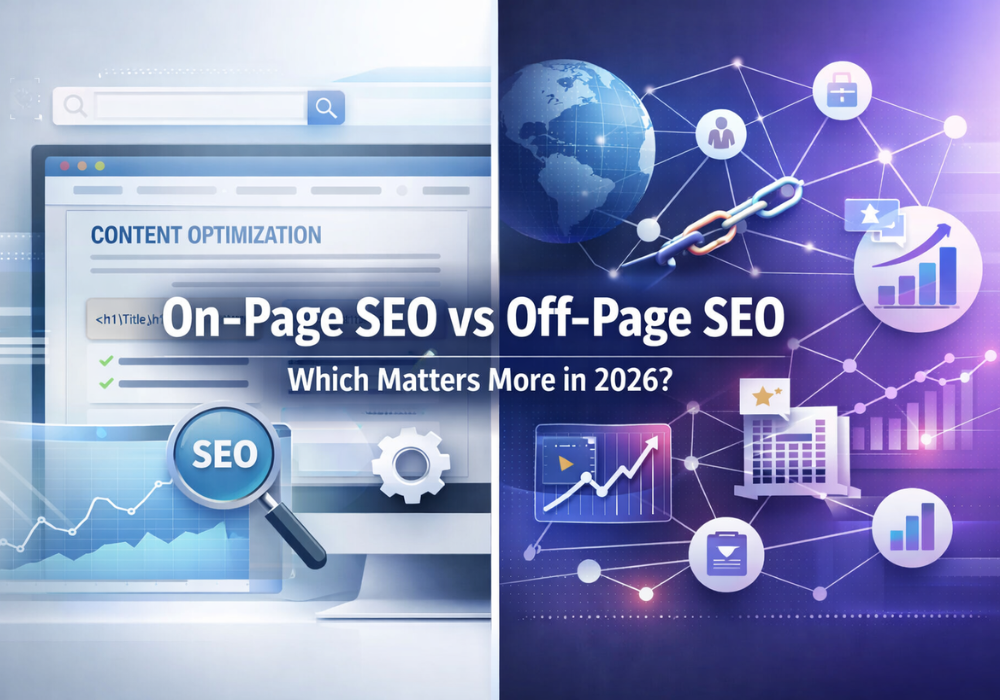
For a long time, the SEO community has revolved around one question: on-page SEO or off-page SEO, which one is more important? In the early days of search, the answer to this question was almost always a resounding “off-page SEO.” The more authority signals you could create off-page, the better your rankings would be.
But 2026 is not 2016.
Search engines have evolved. AI-powered algorithms are now capable of analyzing context, intent, structure, and trust in a way that goes well beyond the simple number of links pointing to a site. Which means that today, the question isn’t just which one is more important, but how they’ve both changed.
Let’s break it down clearly.
What On-Page SEO Means in 2026
On-page SEO includes everything you control directly on your website. Content quality, structure, internal linking, page speed, user experience, semantic clarity, and technical setup all fall under this category.
In 2026, on-page SEO is no longer just about placing keywords correctly. It’s about clarity and understanding.
Search engines now analyze:
- How well your page answers a query
- Whether your content demonstrates topical depth
- How clearly your information is structured
- How pages connect internally
- User engagement signals
AI-driven search systems rely heavily on on-page clarity. If your content is hard to interpret or poorly structured, no amount of backlinks will make it a trusted source in AI summaries or overviews.
On-page SEO has shifted from optimization to communication.
What Off-Page SEO Looks Like Today
Off-page SEO primarily refers to backlinks, brand mentions, authority signals, and external trust factors.
Backlinks still matter. They help search engines understand credibility and domain authority. But in 2026, quality matters far more than volume.
Random link-building tactics that worked years ago are now either ineffective or risky. Search engines can evaluate link context, relevance, and authenticity much more accurately.
Brand reputation also plays a bigger role. Mentions across trusted websites, industry platforms, and authoritative sources contribute to perceived expertise.
Off-page SEO today is about trust validation, not manipulation.
Why On-Page SEO Has Gained More Weight
As search becomes more AI-driven, the engine’s ability to interpret content improves. That shifts more emphasis onto what is actually written and how it’s structured.
If your content:
- Provides clear answers
- Covers a topic comprehensively
- Uses logical internal linking
- Loads quickly and works smoothly
It becomes easier for search systems to trust and reference.
Even strong backlinks cannot compensate for thin, unclear, or outdated content. AI search prefers content it can confidently summarize and rely on.
This is why on-page SEO has become foundational in 2026.
Why Off-Page SEO Still Matters
That said, off-page SEO hasn’t disappeared.
Authority still requires validation from outside your website. Backlinks from relevant and trusted sources signal that others value your content.
In competitive industries, two websites may have similar content quality. In such cases, off-page authority often becomes the deciding factor.
Off-page SEO acts like social proof. On-page builds the knowledge. Off-page confirms the credibility.
Both still matter. But their weight depends on context.
The Shift in Balance
In earlier years, you could rank with average content and aggressive link-building. That balance has changed.
Today:
- Without strong on-page SEO, off-page efforts weaken
- Without off-page signals, high-quality content may struggle in competitive niches
However, if one must come first in 2026, it’s on-page.
Search engines now evaluate understanding before authority. If a page is not clearly useful, links won’t rescue it.
On-page SEO builds the base. Off-page SEO strengthens the structure.
How Businesses Should Approach SEO in 2026
Instead of asking which matters more, businesses should ask whether both are aligned.
A strong strategy in 2026 looks like this:
- Build clear, structured, high-quality content.
- Ensure technical performance and internal linking are optimized.
- Develop authority through relevant backlinks and brand mentions.
The mistake many businesses make is prioritizing one while neglecting the other.
If your on-page SEO is weak, focus there first. If your content is strong but visibility is limited, then off-page authority becomes the next step.
The Role of AI in This Debate
AI-powered search systems evaluate signals differently from traditional algorithms.
They analyze topic depth, semantic connections, user engagement, and consistency across pages. This increases the importance of structured content and topical authority.
Backlinks still contribute to trust, but they no longer override poor user experience or shallow content.
AI search rewards balance, not shortcuts.
Final Thoughts
So, which matters more in 2026?
On-page SEO is the foundation. Off-page SEO is the amplifier.
Without a strong foundation, amplification fails. Without amplification, growth may stall.
The debate isn’t about choosing sides anymore. It’s about understanding that search engines have evolved. SEO today requires clarity, credibility, and consistency working together.
Businesses that adapt to this balanced approach will remain visible, competitive, and trusted as search continues to evolve.
Strengthen Your SEO Strategy the Right Way
Whether you need stronger on-page optimization or better authority signals, a balanced approach is key in 2026. Our SEO services in Kerala focus on building both technical strength and long-term credibility to improve sustainable search visibility.