How We Rank Websites: Our 8-Step SEO Process at Adam Innovations
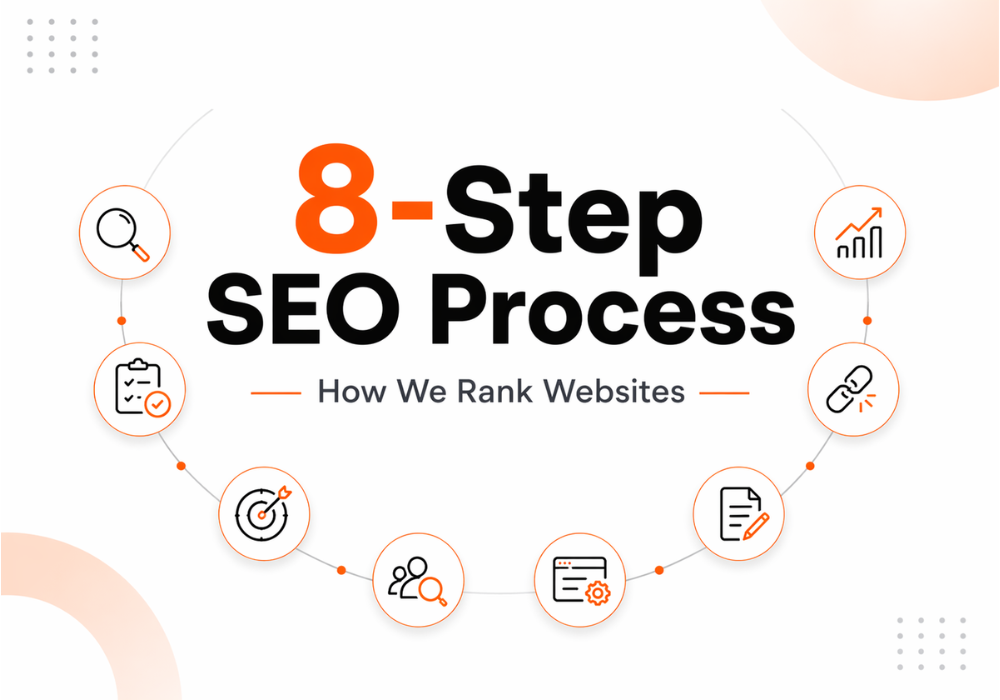
Let’s be honest. Most people who come to us have already tried SEO in some form. Maybe they hired an agency that sent monthly PDF reports with green arrows and zero explanation. Maybe they tried doing it themselves and it kind of worked, until it didn’t. Or maybe they just got told “SEO takes time” every time they asked what was actually happening.
So here’s something we do a little differently: we tell you exactly what we do, step by step, before you even sign with us. No mystery, no buzzword soup. Just the actual process we follow to rank websites, and why each step exists.
First, Why Does Process Even Matter?
Because SEO without a process is just guessing with a budget.
We’ve audited websites where agencies had been “doing SEO” for 18 months, and when we dug in, there was no keyword strategy, no content plan, technical issues that had been sitting there since day one, and a backlink profile that looked like it was built from a random list generator.
The rankings reflected all of that.
Good SEO is methodical. It builds on itself. And when something stops working (which happens, because Google updates are real), a process gives you something to troubleshoot rather than starting over from scratch.
Here’s ours.
Step 1: Discovery and Business Intelligence
Before we open a single SEO tool, we sit down and try to understand your business properly.
This sounds obvious, but most agencies skip it or rush through a 20-minute onboarding call and call it done. We don’t. We want to know what you actually sell, who buys it, why they buy it from you instead of someone else, what your average deal value looks like, and what kind of customer you’re trying to attract more of.
We also ask the uncomfortable questions: Which parts of your business are you not proud of yet? Which competitors do you genuinely respect? What have you tried before that didn’t work?
This matters because SEO strategy that isn’t grounded in business reality is just traffic generation for its own sake. And traffic that doesn’t convert is not a win, it’s a distraction.
What you get out of this: A business brief, audience personas, a map of commercial intent across your customer journey, and a clear picture of who we’re competing against.
Step 2: Technical SEO Audit
This is where we look under the hood.
We crawl your entire website and go through it with a fine-tooth comb: how Google is able to access and index your pages, whether your Core Web Vitals are hurting your rankings, how your site architecture is structured, whether there are duplicate pages cannibalising each other, how your internal links flow, and dozens of other technical factors that most people don’t think about until they become a problem.
In 2026, this step is more involved than it used to be. A lot of websites are built on JavaScript-heavy frameworks that can confuse crawlers. AI-powered search features have changed how certain content gets surfaced. And Google’s patience for technically broken websites has gotten a lot shorter.
We prioritize every issue we find into a tiered list: what’s critical (needs fixing now), what’s high impact, and what can wait. We don’t dump a 200-item checklist on you and disappear. We tell you what actually matters.
What you get out of this: A full technical audit report, a prioritized fix list, and a realistic implementation plan.
Step 3: Keyword Research and Search Intent Mapping
Here’s where a lot of SEO goes wrong.
Ranking for keywords is not the goal. Ranking for the right keywords is. And “right” means something very specific: keywords that real people search when they’re close to making a decision that benefits your business.
We build out a full keyword universe for your site. Not just high-volume terms, but the full picture: informational queries (people learning), commercial queries (people comparing), and transactional queries (people ready to buy or contact). We organise these by funnel stage, competition level, and how much business value they carry.
For clients in India, this gets more nuanced. Search behavior varies a lot between cities, between language preferences, and between industries. Someone searching for a CA in Kochi is using very different terms than someone searching in Pune. We account for that.
Then we map every keyword cluster to a specific page on your website. Existing page, updated page, or new page that needs to be created. Every page gets one clear job.
What you get out of this: A keyword database (usually 300 to 2,000+ terms), a keyword-to-page map, a content gap analysis, and your Month 1-3 priority list.
Step 4: Competitor Analysis and Opportunity Mapping
We look at the 5 to 10 websites that currently outrank you for your most important keywords, and we figure out exactly why.
It’s rarely one thing. Usually it’s a combination of domain authority they’ve built up over years, content that covers topics more thoroughly, a cleaner site structure, and more backlinks from relevant sources. Sometimes it’s just that they’ve been doing this longer.
What we’re really doing in this step is looking for gaps. Topics they haven’t written about. Keywords where their content is thin. Backlink sources they haven’t tapped. Audience segments they’re not speaking to. Every gap is an opportunity.
We package this into what we call an Opportunity Gap Report. It’s a plain-language look at where you stand today versus where your competitors stand, and the specific moves that would close that distance over the next 6 to 12 months.
What you get out of this: A competitive authority comparison, a backlink gap breakdown, a content opportunity list, and rough timeline projections for your target keywords.
Step 5: On-Page Optimisation
Now we start working on your actual pages.
On-page optimisation covers everything that lives on the page itself: title tags, meta descriptions, heading structure, how and where your keywords appear in the content, how the page links to other pages on your site, image alt text, URL structure, and schema markup (the structured data that helps Google understand what your content is about).
We also pay close attention to E-E-A-T signals right now. That stands for Experience, Expertise, Authoritativeness, and Trustworthiness. Google has leaned heavily into this framework, especially for industries like finance, health, and legal services. It affects not just what you write, but how your brand is presented, who’s credited as the author, what your About page says, and how your business is referenced elsewhere online.
For pages that need significant content improvements, we write detailed briefs (or rewrite the content ourselves, depending on the engagement). We don’t just move keywords around and call it optimised.
What you get out of this: Optimised meta data across all target pages, updated or new content, schema markup, and an improved internal linking structure.
Step 6: Content Strategy and Creation
This is probably the step with the biggest long-term payoff, and it’s also the one most businesses underestimate.
We build a content plan based on the keyword research and gaps we identified earlier. Blog posts, pillar pages, FAQ pages, landing pages for specific services or locations, whatever the site actually needs. Each piece has a job: target a specific keyword cluster, serve a specific audience intent, and link to related content on the site.
We use a topic cluster approach. Think of it like a hub and spoke. You have a main pillar page on a broad topic, and multiple smaller pages that go deep on subtopics, all linking back to the pillar. This structure signals to Google that your site is genuinely authoritative on a subject, not just dabbling in it.
For our Indian clients, we also think carefully about context. A piece of content written for a global audience and lightly edited for India is not the same as content written for someone sitting in Bengaluru or Hyderabad trying to solve a real local problem. The examples, the references, the assumed knowledge level: it all matters.
What you get out of this: A rolling 3-6 month content calendar, content briefs or finished content, and a content performance tracking setup from day one.
Step 7: Link Building and Authority Development
Let’s talk about backlinks honestly.
They still matter. A lot. The number of quality websites linking to yours is one of the clearest signals to Google that your site is worth trusting. That hasn’t changed, even with all the algorithm updates over the years.
What has changed is that shortcuts don’t work anymore, and some of them will actively hurt you. Buying links in bulk, getting listed on low-quality directories, publishing thin guest posts on irrelevant sites just to get a link back: Google has gotten very good at spotting this, and the penalties are real.
Our link building is entirely white-hat. That means earning links by creating things worth linking to, getting your brand covered in relevant publications, building genuine relationships with other websites in your space, and making sure your business is accurately listed across the directories and citation sources that matter for your industry.
For local businesses in India, citations are especially important: Google Business Profile, Justdial, Sulekha, IndiaMART, and industry-specific platforms all contribute to how Google verifies your business’s legitimacy.
What you get out of this: Monthly link acquisition reports, domain authority tracking, local citation cleanup, and disavow file management if there’s any toxic link history to deal with.
Step 8: Reporting, Analysis, and Ongoing Optimisation
This is the step that separates a good agency from one that just sends you a PDF every month and hopes you don’t ask too many questions.
We set up a live dashboard for every client that shows organic traffic, keyword rankings, click-through rates, Core Web Vitals, and conversions from organic search. You can check it any time, not just when we send a report.
Every month, we have a strategy call. Not a “here’s what went up and here’s what went down” meeting. An actual conversation: what are the numbers telling us, what do we do about it, what are we testing next quarter.
We also do a full SEO audit every quarter. Google updates its algorithm constantly. Competitors don’t stand still. What was working in January might need adjusting by April. Quarterly reviews keep the strategy sharp and make sure nothing is quietly drifting in the wrong direction.
What you get out of this: Monthly reports, a live dashboard, a keyword ranking tracker, quarterly strategy reviews, and a team that’s actually paying attention between calls.
How Long Before You See Results?
We get this question every single time, and we always answer it the same way: it depends, but here’s the honest range.
For most websites in competitive Indian markets:
- Months 1-2: Technical issues get fixed, pages get optimised, initial content goes live. You’ll see crawl improvements and some early keyword movement.
- Months 3-4: Content starts gaining traction. Some of the pages we optimised in Month 1 begin showing up on Pages 1 and 2. Backlinks start contributing to authority.
- Months 4-6: Traffic starts climbing. You’ll see Page 1 rankings for lower-competition terms. Leads from organic start appearing.
- Months 6-12: The compounding effect kicks in. Competitive keywords move to Page 1. Organic becomes a predictable lead source.
- Month 12+: This is where the investment really pays off. A well-executed SEO strategy at this stage is generating traffic and leads continuously, without the ongoing cost of ads.
These timelines assume we’re executing all 8 steps consistently. If things slow down or stall, we tell you why. There’s always a reason, and we’d rather give you the truth than a reassuring non-answer.
Why Work With Adam Innovations?
We’re not the biggest agency in India, and we’re not trying to be. We work with a focused number of clients so we can actually deliver on what we promise.
A few things that matter to us:
We don’t do black-box SEO. You know what we’re doing, why we’re doing it, and what it’s supposed to accomplish. Always.
We tie everything to business outcomes. Not just rankings and traffic, but actual leads, customers, and revenue where we can measure it.
And we build things that last. Quick wins are great when they happen, but we’re more interested in building organic search into a long-term growth channel for your business.
If any of that sounds like what you’ve been looking for, we’d love to talk.
Want to See How This Applies to Your Website?
Book a free strategy call and we’ll walk you through where your site stands today and what it would take to move it.
Or email us directly at [email protected] and we’ll get back to you within 24 hours.